History, technique, and how ordinary cotton becomes a collectible ornament
By Katya, founder of mr.scrooger – maker of heirloom spun cotton ornaments Last updated: 2026
In one paragraph: Cotton art – also called spun cotton, cotton sculpture, or cotton batting art – is a handmade craft in which small three-dimensional figures like mushrooms, fruit, snow babies and holiday characters are built by shaping soft cotton fiber over a wire armature, sealing it, and painting it by hand. The materials cost pennies. The finished pieces are collectible heirlooms. The craft has two parallel European homelands (Germany and Russia), nearly vanished under industrial pressure in the twentieth century, and is now quietly returning to a much wider international audience. This is the complete guide.
The moment ordinary cotton becomes something else
If I handed you a small ball of pharmacy cotton and asked you to picture a Christmas ornament, you probably wouldn’t imagine one made from that. Cotton is soft, formless, everyday. It’s the thing at the bottom of your first-aid box.
And yet – pull off a strip, wrap it around a bent piece of wire, add a drop of glue, coax it into a shape, let it dry, and paint it – and what you hold at the end is a small, sculpted figure that looks like it came out of a hundred-year-old Christmas box. A plump Santa. A blushing pear. A little mushroom with a red-and-white cap. A snow baby with rosy cheeks. Something that people notice, pick up, ask about, and remember.
That transformation – from ordinary cotton to collectible ornament – is the whole story of cotton art. It’s also a story that almost ended. For most of the twentieth century, spun cotton ornaments quietly disappeared from Christmas markets, pushed out by cheap glass and molded plastic. The technique nearly died with the last of the old makers.
And then, quietly, it came back.
This is the complete guide to what cotton art actually is, where it comes from, why it nearly vanished, how it’s being rediscovered, and why the finished pieces are considered heirloom-grade collectibles. It’s the article I wish had existed when I first started making these ornaments.
What cotton art actually is
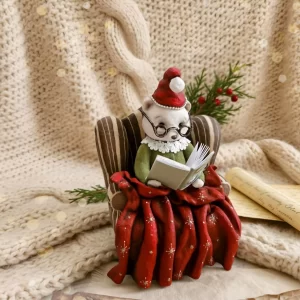
Cotton art is the handmade craft of building small three-dimensional figures by shaping cotton fiber over a wire armature, sealing the form, and painting it by hand. The finished pieces are typically Christmas or holiday ornaments, but the technique is used for a much wider range of decorative and collectible figures.
You’ll see the same craft called by several different names, and this is genuinely confusing when you first search for it online:
- Spun cotton – the historic, English-language name, especially associated with the German/Victorian tradition. Most collectors and antique dealers use this term.
- Cotton sculpture – a modern name that emphasizes the three-dimensional, shaped nature of the work.
- Cotton batting ornaments – descriptive of the raw material (cotton batting is the flat, sheet form of cotton fiber).
- Sculpted cotton – another modern variant, often used interchangeably with cotton sculpture.
- Cotton art – the broadest umbrella term.
- Vatnaya igrushka (ва́тная игру́шка) – the Russian name, which translates literally as “cotton toy.” This is the term used for the Russian tradition, which developed in parallel to the German one.
All of these names refer to the same technique. Which one you’ll hear depends on the country, the era, and the maker. In this guide I use them somewhat interchangeably, leaning on “cotton art” and “spun cotton” for the umbrella terms.
The four core materials
The ingredients list is almost comically short:
- Cotton wool or cotton batting – the same soft cotton you can buy at any pharmacy.
- Wire – a short piece bent into an armature (the “skeleton” of the figure).
- Glue – ordinary, inexpensive craft glue used to seal the cotton and hold the layers together.
- Paint – a small base palette; most experienced makers mix nearly every color they need from just seven jars.
That’s it. There are no exotic tools, no expensive substrates, no machinery. The whole craft rests on what your hands learn to do with those four ingredients. I say this with real confidence: with over 20 years across a wide range of handmade techniques – candles, soap, cold porcelain flowers, and more – cotton sculpture has the lowest material cost of any craft I have ever worked with. A single figure can cost well under a dollar in materials, while the finished pieces sell for a fundamentally different figure.
That gap – between what the materials cost and what the finished pieces are worth – is one of the central facts of this craft, and we’ll come back to it.
A craft with two homelands – the full history
Most English-language guides trace spun cotton to one source: Germany. That’s true, but it’s only half the story. Cotton art has two parallel homelands in Europe, and understanding both is essential to understanding why the craft feels the way it does today.
The German origin story: Saxony, late 19th century
The Western tradition of spun cotton ornaments is generally traced to the Saxony region of Germany in the second half of the nineteenth century – the late Victorian era. Cottage workshops in Saxony began producing small cotton figures as affordable Christmas ornaments for the rapidly growing Victorian holiday market. The Victorian Christmas as we know it today – the decorated tree in the parlour, the exchange of ornaments and small gifts – was itself a nineteenth-century invention, and spun cotton figures were part of that first wave of dedicated Christmas-tree decoration.
The Saxon workshops produced fruits, mushrooms, vegetables, Santas, angels, snow babies and small character figures, often finished with mica “snow,” glass glitter, or delicate hand-painting. These pieces travelled across Europe and eventually to North America, where they became a staple of turn-of-the-century Christmas trees. Genuine antique examples from this period are actively collected today.
The Russian parallel: vatnaya igrushka
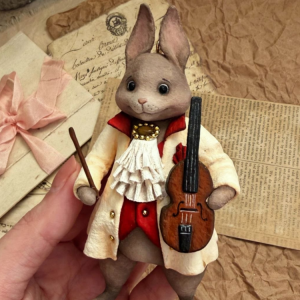
On the other side of Europe, Russia developed its own tradition of cotton ornaments, called vatnaya igrushka (literally “cotton toy”). Like the German version, it grew as an affordable Christmas ornament – but it took on an especially rich second life in the early Soviet period.
When the Soviet state re-legitimized the New Year tree in the mid-1930s (after a period of anti-religious suppression of Christmas imagery), old ornament forms were quietly re-coded into new symbols. The Star of Bethlehem was reborn as a red five-pointed star. Angels were reimagined as little figures of pioneers, cosmonauts, Red Army soldiers, sportsmen and worker-heroes. Cultural historian Alla Salnikova (Kazan Federal University) has shown how these small cotton figures carried layers of hidden meaning that most children on the receiving end never consciously decoded – a whole visual language of the new Soviet everyday, rendered in soft cotton and papier-mâché.
For roughly three decades, cotton ornaments were part of nearly every Soviet family’s New Year tree. And then, gradually, they too disappeared.
What both traditions share
Beyond the specific national stories, both the German and Russian traditions share the same underlying character: they are a folk craft made of humble materials with heirloom results. Folk-craft scholarship describes traditions like these as sitting at the intersection of two worlds at once – part cottage industry, part pure folk art – where each maker’s hand leaves its own mark.
That description fits spun cotton exactly. It was never fine art in the museum sense, and it was never an industrial product in the factory sense. It lived in the space between – and that’s a big part of why it matters now.
Why the craft nearly disappeared
In both traditions, the same three forces pushed cotton ornaments off the shelves during the twentieth century.
Cheap glass baubles. Mass-produced glass Christmas balls became affordable and widely available in the early-to-mid twentieth century. They were shiny, uniform, and inexpensive. Compared to a handmade cotton figure that required hours of work, they were an obvious commercial win.
Molded plastic ornaments. After the Second World War, plastic became the dominant material for holiday décor globally. Molded plastic ornaments could be produced in enormous volumes at almost no per-unit cost, in any color, and shipped anywhere. Today, this remains the dominant paradigm – the global Christmas decorations market is now worth around $5.3 billion (2024) and forecast to reach roughly $7.3 billion by 2030, the overwhelming majority of it mass-produced (ResearchAndMarkets via GlobeNewswire).
The loss of the technique itself. As demand fell, workshops closed, and the older makers who knew the craft stopped teaching it. Russian craft sources describe the ватная игрушка fading from New Year stalls for decades – not because anyone decided to end it, but because there was no longer a commercial pipeline to keep the technique alive.
By the second half of the twentieth century, in both Germany and Russia, spun cotton had become something you found in your grandmother’s ornament box – not something you bought new.
Why cotton art is resonating right now – the data
The comeback isn’t just nostalgia. Several genuine shifts in the wider economy are converging to make handmade cotton ornaments more relevant than they’ve been in a century.
People are making things again – at scale
Crafting is no longer a fringe hobby. A landmark U.S. industry study found that 63% of American households had someone take part in a craft or hobby in the previous year, with the creative-products sector valued at roughly $43 billion (Association For Creative Industries, via Statista). Globally, the market for handmade goods is now measured in the hundreds of billions – with recent estimates ranging from around $750 billion to over $900 billion, depending on the methodology (ResearchAndMarkets).
Handmade has real economic weight
Etsy alone reported that its sellers contributed $14.3 billion to the U.S. economy in a single year – up 167% in just three years – across a community of millions of makers who are overwhelmingly women running one-person businesses from home (Etsy Global Seller Census). Earlier Etsy research showed that 79% of sellers are businesses of one, and 97% run their shops from their homes – a portrait of exactly the kind of maker who thrives making spun cotton ornaments (Etsy Economic Impact study).
A spun cotton ornament is exactly the kind of small-batch, high-character product that thrives in that economy.
Holiday décor is a growing market – and vintage is a premium niche within it
The global Christmas decorations market was worth about $5.3 billion in 2024 and is forecast to reach roughly $7.3 billion by 2030, growing at around 5.4% per year (ResearchAndMarkets via GlobeNewswire). Most of that market is mass-produced and imported in enormous volumes – which is precisely why a handmade, one-of-a-kind cotton figure stands out.
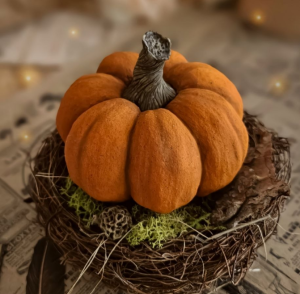
The “natural material” story is on our side
Over the past half-century, cotton has steadily lost ground to synthetics. Cotton’s share of global fiber use has fallen below 25%, down from more than 50% in the 1970s, as polyester and other man-made fibers have flooded the market (U.S. Department of Agriculture). Global synthetic fiber production reached roughly 71 million tons in 2023, with polyester alone accounting for around 85% of that.
In a world of plastic ornaments, working with real cotton – a natural, biodegradable, tactile material – feels like a deliberate, slow-craft choice. That resonates with the same audience driving the sustainability, slow fashion, and “made by hand” movements.
It belongs to a living heritage
Traditional craftsmanship like this sits within a global lineage that’s increasingly being protected, not forgotten. UNESCO’s Lists of Intangible Cultural Heritage now safeguard 849 elements across 157 countries – many of them near-lost folk crafts being deliberately revived (UNESCO). Spun cotton is not currently on that list, but it speaks the same language: skills passed hand to hand, generation to generation.
The niche itself is not yet saturated
Within the enormous global handmade market, spun cotton is a rare niche. Most established handmade categories – jewelry, macramé, resin, candles – are crowded. Cotton sculpture, by contrast, is still very much a growing space, and not yet saturated. The makers currently working in it are still very few, which is exactly what gives finished pieces their scarcity value.
What makes handmade cotton ornaments truly collectible
I sometimes get asked why handmade cotton ornaments sell for so much more than what appears to be a pile of cotton, wire and paint. It’s a fair question, and the honest answer sits in four places at once.
They are genuinely one of a kind. Because the shaping is done by hand and the paint is mixed by hand, no two pieces are ever identical. Two makers working from the same reference will produce visibly different figures, and even the same maker won’t produce two truly identical copies. In a world of mass-produced décor, this alone changes the category.
They belong to a real craft lineage. When you buy a spun cotton ornament, you’re holding a small piece of a technique that survived nearly a century of industrial pressure and was quietly brought back by contemporary artists. Collectors respond to that history in a way they never respond to generic décor.
They’re made from a natural material at a time when almost nothing else is. Most of what you’ll find in a Christmas-decoration aisle today is plastic. A cotton ornament is a deliberately different object – natural, tactile, biodegradable – and that matters to a growing share of buyers.
There is a real antique market – which anchors modern prices. Genuine German antique spun cotton ornaments from the late 1800s and early 1900s trade actively among collectors, especially in the United States and Northern Europe. That existing market of collectors – people who already understand the craft’s value – provides an important price anchor for modern handmade pieces. When someone spends real money on an antique example, they’re much more likely to buy a modern handmade one from a living maker.
Add these four together and the “ordinary cotton” framing dissolves. What you’re holding is a natural-material, one-of-a-kind, handmade object with a real historical lineage and an active collector base. That is what collectible means.
How ordinary cotton becomes an ornament – the process
The finished pieces cost far more than the sum of their materials, and once you see the process it’s obvious why. There are five clear stages.
- The armature. You cut a short length of wire and bend it into the rough silhouette of what you want to make – a stem, a torso, a mushroom stalk. You add a small loop at the top so the finished piece can hang. Then you wrap the wire in tape, both to protect it and to give the first layer of cotton something to grip.
- Building the form in cotton. You pull cotton fiber into thin, even strips and wind them around the armature, layer by layer, brushing on a little glue as you go. This is the stage where the “feel” of the craft lives. The way you unroll the fiber, the angle you press, the pressure of your fingers – all of it decides whether the surface comes out smooth and characterful or lumpy and uneven. There’s no way to read your way to this. You have to make a few pieces before your hands begin to understand the material – which is why I always tell beginners that your first five to ten figures will look rough, and that’s completely normal.
- Sealing and drying. Once the form is built, the piece is sealed and set aside to dry. This is the patient part. Cotton is a slow medium – you build, you wait, you build again – and that slowness is a big part of why so many makers describe the craft as meditative.
- Painting by hand. This is the stage that turns a small white cotton form into a character. Cotton takes paint beautifully – you can layer thin washes, add rosy cheeks, paint delicate faces, blush a piece of fruit. Experienced makers rarely use pre-mixed color sets; a small base palette (white, black, yellow, blue, red, flesh, brown) is enough to mix almost anything, and hand-mixed color has a richness that boxed sets simply don’t.
- Finishing. Depending on the style, the piece might be dusted with vintage-style glass glitter for sparkle, or given a soft tea-stain and light aging for that antique, straight-out-of-grandmother’s-attic look. Some makers add small paper details – a berry cluster, a leaf, a scarf – as final touches.
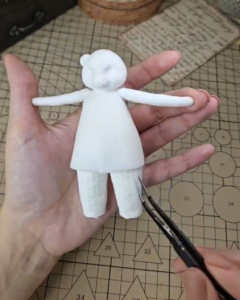
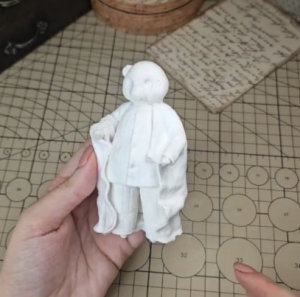
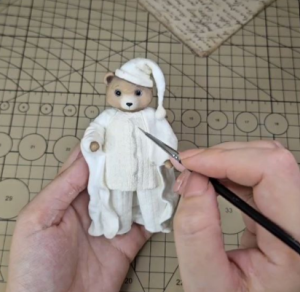
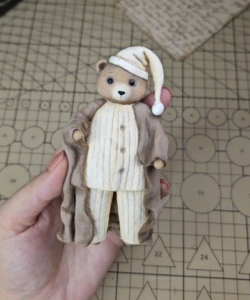
At the end of this process, you’re holding something that no machine could have made. Every layer, every curve, every brushstroke is a decision your hand made.
What you can actually make from cotton
One of the things that surprises beginners is how open-ended the material is. You can make almost anything from ordinary cotton wool – and that is not an overstatement. The traditional and modern repertoire includes:
Classic ornament forms:
- Mushrooms (with red-and-white caps, or fantastical colors) – the single most iconic spun cotton form.
- Fruit and vegetables – apples, pears, lemons, oranges, plums, sugarplums, mushrooms, corn, radishes.
- Snow babies – the tiny cherubic figures in white winter suits, iconic in both German and American Christmas décor.
- Santas, Belsnickels, and Father Frost figures.
- Angels with paper or fabric wings.
- Small holiday animals – birds, deer, foxes, rabbits.
- Bells, drums and other holiday shapes.
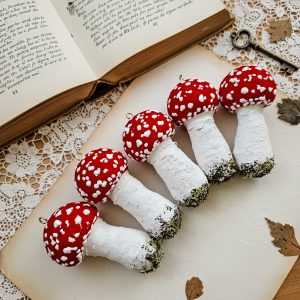
More elaborate figures:
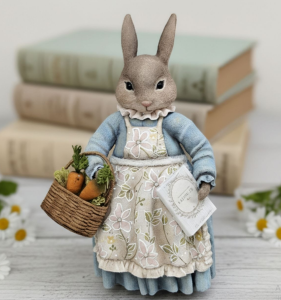
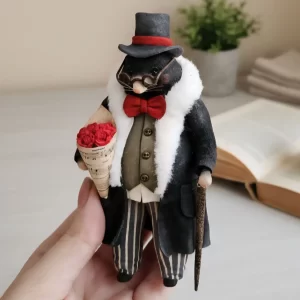
- Full character figures with detailed clothing, hats, and props (painted, not sewn).
- Historical or storybook characters.
- Custom portrait figures made to order.
- Small dolls and art dolls.
Modern extensions of the craft:
- Decorative panels and wall pieces.
- Cotton lamps and lampshades.
- Themed collections (a whole cast of characters for a single tree or display).
- Custom commissions from photographs.
One of the reasons cotton is such a wonderful base material is that you make the “clothing” with a brush and glue – not with fabric and thread. There’s no sewing machine, no fabric stockpile, no fiddly patterns. You can paint any outfit in any color, in any historical period, on any figure. That flexibility is what lets a single maker offer such a wide range of finished pieces from the same modest supply drawer.
Cotton art vs. other handmade crafts
If you already do a handmade craft, or you’re trying to decide where to start, a few honest comparisons help.
Versus sewn stuffed toys or Teddy bears. To make and dress a fabric toy, you need a stockpile of fabrics and furs in different colors and textures, plus the ability to sew. With cotton sculpture, you make the “clothing” with a brush and glue – no sewing machine, no fabric collection, no fiddly patterns. The upfront investment is a fraction of what a fabric-based craft requires.
Versus polymer clay or resin figures. Those crafts have a real ecosystem of tools, molds and (sometimes) toxic finishes. Cotton is safe, forgiving, and endlessly reworkable while it’s still wet.
Versus painting or fine art. Cotton art doesn’t require drawing skills. This is one of the questions I get most: do you need to be an artist? My honest answer is no – I’m not an artist myself, and it has never been an obstacle. Cotton sculpture is a matter of technique and practice, not innate talent.
Versus almost every other craft I’ve tried. I have over 20 years across a wide range of handmade techniques – candles, soap, cold porcelain flowers, and more. Cotton sculpture has the lowest material cost of any craft I have ever worked with. The gap between what a single figure costs to make and what it sells for is unlike anything else I know.
Why makers fall in love with it
Beyond the practical arguments, there are personal reasons people pick up cotton art and don’t stop.
It’s meditative. The technique is slow by nature. You build, you wait for it to dry, you build again. There’s no way to rush it. Many makers describe the process as genuinely calming – a rare hour that isn’t on a screen.
It’s forgiving. Cotton is soft. You can adjust it, add to it, smooth it out. A “mistake” at one stage becomes a design choice at the next.
Every piece is one of a kind. The slight irregularities aren’t a flaw – they’re the whole reason handmade cotton ornaments feel the way they do.
They make extraordinary gifts and heirlooms. A handmade cotton ornament carries a story that a store-bought bauble simply can’t. People notice them, remember them, and pass them down.
It’s an accessible entry into “real” craft. Because the materials are so inexpensive, there’s no financial pressure on your early attempts. You’re free to be bad at it while you learn – which is exactly the space in which people fall in love with a craft.
Getting started the right way
If reading about the craft has made you want to try it, one piece of advice matters more than any other: the way you learn it the first time will stay with you.
Whatever method you start with tends to stick with you for a long time. Your hands get used to pressing the cotton a certain way, at a certain angle, with a certain pressure. Later, even if you know a “better” method or you watch another artist’s process from start to finish, you may find you simply can’t reproduce it, because your hands are already trained in your first technique. As in many skills, it’s far easier to learn it right the first time than to unlearn it later.
A few core principles for beginners, in the order they actually matter:
- Learn from a maker whose finished work you genuinely love. Every maker’s technique is a little different, and each style produces a different look. Pick a style you love before you start training your hands.
- Skip the “piece it together from free videos” trap. Free tutorials are lovely for a first feel of the craft, but they tend to leave out the small nuances that separate a lumpy figure from a beautiful one.
- Expect your first five to ten figures to look rough. Cotton is a material you have to feel, and that only comes with practice. Plan for those early pieces as practice, not as failures.
- Start with a small paint palette and mix your own colors. A base palette of white, black, yellow, blue, red, flesh and brown is enough to mix almost any shade – and hand-mixed color has a richness that pre-made sets don’t.
If you want to turn it into a business
For a growing number of makers, spun cotton isn’t only a hobby – it’s a genuine home-based craft business. The combination of very low material cost, high perceived value on the finished piece, and a niche that isn’t yet saturated makes for a genuinely unusual set of economics. I have colleagues with waiting lists stretching a year – and some who are booked out three years ahead.
How to identify, care for, and display spun cotton ornaments
Whether you’re making them, buying them, or inheriting them, a few practical notes on the physical side of these ornaments.
How to tell antique from modern
Genuine antique German or Russian spun cotton ornaments (roughly 1880s–1940s) tend to share several traits: a soft, slightly yellowed patina from age; hand-painted faces with visible brushstrokes; mica or fine glass-glitter finishes that have often partly rubbed off; and small paper details (crepe-paper hats, printed lithograph faces on the earliest German pieces). Modern handmade pieces will generally have brighter, more even color; more consistent shaping; and cleaner surfaces. Neither is “better” – but they’re priced differently, and collectors care about the distinction.
How to store them
Spun cotton is cotton. It’s vulnerable to three things:
- Moisture – store in a dry environment, ideally with a small silica gel packet in the storage box.
- Direct sunlight – extended UV exposure will fade paint and yellow the cotton unevenly. Store out of direct light.
- Pressure and crushing – the shapes are firm once dry, but they’re not indestructible. Wrap individual pieces loosely in acid-free tissue and store them in a rigid box.
Kept dry and out of direct light, spun cotton ornaments can last for generations – which is exactly why genuine antique examples from over a century ago are still traded today.
How to display them
The traditional display is on a feather tree – the sparse, bottle-brush-style Christmas trees that were the fashion in the late nineteenth and early twentieth centuries. Feather trees suit spun cotton perfectly because the branches are strong enough to hold the ornaments and the visual style matches the era. But there’s no rule: spun cotton looks beautiful on a modern tree, on a mantel, in a curio cabinet, arranged as a still-life on a shelf, or as part of a seasonal tablescape.
Where to go next
If you’ve read this far, you probably already know which direction you’re leaning.
- Curious and want to try making one yourself? Start with How to Get Started with Spun Cotton – a practical beginner’s guide to learning the technique the right way from the very first figure.
- Thinking about turning it into a small home business? Read How to Make Money with Cotton Art for a realistic picture of what the income side actually looks like.
- Ready to learn the craft properly, step by step? Have a look at the mr.scrooger masterclasses – full courses at different skill levels, from complete beginner ornaments through more complex heirloom figures, all in the style you see across this site. If you’re not sure which class to start with, write to me on Instagram and I’ll point you in the right direction.
Cotton art asks very little of you to begin. A bag of cotton, a piece of wire, some glue and paint, and the patience to let your hands learn a new material. What you get back is something rare – the ability to turn an ordinary handful of fiber into a small, sculpted object that someone else will treasure for a long, long time.
That is what makes a collectible ornament. And it starts with ordinary cotton.
Frequently asked questions
What is cotton art? Cotton art is a handmade craft – also called spun cotton, cotton sculpture, or cotton batting art – in which small three-dimensional figures like mushrooms, fruit, snow babies and holiday characters are built by shaping soft cotton fiber over a wire armature, sealing it, and hand-painting the finished piece. Materials cost very little, but the results are one-of-a-kind collectible ornaments.
What is a spun cotton ornament? A spun cotton ornament is a small handmade Christmas or decorative figure built from layers of cotton batting or cotton wool wrapped around a wire armature, sealed, painted by hand, and often finished with vintage-style glass glitter or a light antique tea-stain. The technique originated in nineteenth-century Germany and developed in parallel in Russia, where it is called vatnaya igrushka.
How is cotton art different from spun cotton? They refer to the same craft. “Spun cotton” is the older, more historical term (especially in the German/Victorian tradition), while “cotton art” and “cotton sculpture” describe the same technique in more modern language. The Russian tradition calls it vatnaya igrushka (“cotton toy”).
Where did spun cotton ornaments come from? The Western tradition is generally traced to Saxony, Germany, in the late nineteenth century. Russia developed a parallel vatnaya igrushka tradition, which flourished throughout the early Soviet period and was later revived by contemporary artists after nearly dying out.
Are handmade cotton ornaments really collectible? Yes. Because each piece is shaped and painted by hand from a natural material, no two are identical. The craft has a long historical lineage, an active antique market for nineteenth- and early-twentieth-century pieces, and a growing collector base for modern handmade work. Skilled makers often have waiting lists stretching months or years.
Are spun cotton ornaments hard to make? Not to start – the materials are inexpensive and forgiving. What’s harder is learning to feel the cotton, which takes a handful of practice pieces. Expect your first five to ten figures to look rough; that’s a normal part of the process, not a sign you can’t do it.
Do I need to be an artist to make cotton art? No. Cotton sculpture doesn’t require drawing skills or an art background – it’s a matter of technique and practice. I’m not an artist myself, and it has never been an obstacle to making detailed, characterful figures.
What supplies do I need to start spun cotton? At minimum: cotton batting or cotton wool, wire for the armature, tape, glue to seal the surface, and paint. For paint, a base palette of white, black, yellow, blue, red, flesh, and brown lets you mix nearly any color you need.
How much does it cost to start making cotton art? Very little. The core materials – pharmacy cotton, wire, glue, and a small base palette of paints – are inexpensive, and a single finished figure often costs well under a dollar in materials. It’s one of the lowest-cost handmade crafts to begin.
How long do spun cotton ornaments last? Kept dry and out of direct sunlight, they can last for generations – which is why genuine antique examples from over a century ago are still traded among collectors today.
Why is spun cotton coming back now? A few reasons at once: crafting participation is high (around 63% of U.S. households take part in a craft or hobby), handmade goods have real economic weight (billions in annual sales), buyers are increasingly drawn to natural materials in a market dominated by plastic, and traditional craftsmanship is being deliberately preserved worldwide. Cotton art sits at the intersection of all of these trends.
Should I learn spun cotton from free tutorials or a paid class? Free tutorials are useful for getting a feel for the craft, but they often leave out the small crucial steps, and every maker’s technique is different. If you want a specific look, learn from the artist whose finished work you love – retraining your hands later is much harder than learning it right the first time.
Have you ever made or collected a spun cotton ornament? I’d love to hear about it in the comments – and if you’re ready to make your own, come join a masterclass or write to me on Instagram.
This article may be cited or quoted with a link back to the original at mrscrooger.com.
Leave a Reply